image002-1
Home » 2027 Medicare

Medicare

As you plan to retire, it’s a good idea to brush up on important information you’ll need to make the most of the money set aside in retirement accounts, how Medicare works and what you can expect in Social Security benefits.

There are key milestones that can make a significant impact on your retirement tax implications. Once you are 59 1/2, you are no longer subject to the 10% early-withdrawal penalty from your IRA or 401(k). At age 72, you will be required to take minimum distributions from traditional IRAs and 401(k).  Just because you are required to take a minimum distribution from your traditional IRAs or 401(k) plan, you don’t have to spend the money. You can invest into stocks or a Roth IRA.

Click the following tabs to explore Medicare.

Excelligence generally recognizes normal retirement age as 65. Excelligence also recognizes certain definitions of “Early Retirement” in some of its benefit plans, however, Excelligence does not have an Early Retirement Program; this is solely used as reference to a specified number of years of service and age that meet certain requirements under our benefit plans.

Retirement is considered one form of resignation, and therefore, our normal resignation policies do apply regarding notifications.

NOTE: When calculating “years of service”, one must always refer to the “continuous service date” in (Company HRIS System). This is the date that encompasses the total accumulation of service including prior service for rehires and those involved in acquisitions. NO OTHER DEFINITION/FIELD MAY BE USED.

To help you transition into the new retired stage of life, we have compiled a resource, with key information to help you know what to expect. 

Medicare is a federal health insurance program that covers medical services and supplies in hospitals, doctors’ offices and other health care settings. You qualify for Medicare if you are age 65 or older.* Medicare has four components:**

Part A: Hospital Insurance

Part B: Medical Insurance

Part C: Medicare Advantage Plans

Part D: Prescription Drug Coverage 

Your age when you collect Social Security has a big impact on the amount of money you ultimately get from the program. The key age to know is your full retirement age. For people born between 1943 and 1954, full retirement age is 66. It gradually climbs toward 67 if your birthday falls between 1955 and 1959. For those born in 1960 or later, full retirement age is 67. You can collect Social Security as soon as you turn 62, but taking benefits before full retirement age results in a permanent reduction — as much as 25.83% of your benefit if your full retirement age is 66. Click Here for more information.

Upon turning 65 – you should enroll in Medicare Part A:  Hospital Insurance – this is typically free to you and will cover hospital costs, even if you already have other coverage.  You will be assigned a Medicare number and be sent the pretty Red, White and Blue Medicare Card. 

DO NOT WAIT TO SIGN UP FOR PART A ONCE YOU ARE ELIGIBLE

You may also enroll in Part B:  Medical at this time.  The cost per month in 2026 is $202.90 per month with a yearly deductible of $283.  The cost for 2027 will be $209.50 and the yearly deductible will be $292.00.  If you are covered under an employer plan, yours or your spouses, you do not have to enroll in Part B just yet. 

When you are ready to enroll, you will need to sign into your Social Security site and complete the CMS-40B Application for Medicare.  You will need your employer to complete the CMS-L564, Proof of Coverage.

Once you enroll in Part B, your are welcome to sign up for an Advantage Plan (Part C) for things not covered by original Medicare, Part B.  These plan can typically be premium free.  There are six (6) different types of Medicare Advantage Plans:

  1. Health Maintenance Organizations Plans (HMO’s)
  2. Point of Service Plans (POS)
  3. Preferred provider Organizations Plans (PPO’s)
  4. Private-Fee-For-Service Plans (PFFS’s)
  5. Special Needs Plans (SNP’s)
  6. Medical Savings Account Plans (MSA’s)


One size doesn’t fit all.  Even you and your spouse may have different Part B plans.  These plans also typically include Dental, Vision and Prescription.  This is where you might need to speak with a Medicare Agent or do your homework and investigate plans in your zip code area.

Medicare is not a scary thing and may actually save you money and give you richer benefits.

Medicare is a federal health insurance program that covers medical services and supplies in hospitals, doctors’ offices and other health care settings. You qualify for Medicare if you are age 65 or older.* Medicare has four components:**

Part A: Hospital Insurance

Part B: Medical Insurance

Part C: Medicare Advantage Plans

Part D: Prescription Drug Coverage 

You have three opportunities to enroll in Medicare
 Definition When Coverage Begins
Initial Enrollment Period 7 months, starting three months before you turn 65, the month of your birthdayand ending three months after the month you turn 65 First of the month you turn 65***
General Enrollment Period January 1 - March 31 July 1
Special Enrollment Period 60 days after group health plan coverage ends First of the month following month you enroll in Medicare

If you are collecting Social Security benefits at least four months before turning 65, then you are automatically enrolled in Medicare Parts A and B.

If you are within three months of turning 65 and not collecting Social Security benefits, you must enroll in Medicare one of three ways:

Online: www.socialsecurity.gov/retirement

Phone: 800-772-1213

In person: your local Social Security office

In that case, you may delay enrolling in Medicare without paying a penalty if your employer is registered as having over 20 employees. If you do enroll in Medicare while on your employer’s or spouse’s group health plan, your employer-based plan will generally pay first for any health care services you receive if your employer plan is an over 20 registered plan. If your employer is less than 20 registered, you MUST have Medicare.

If your employer is registered with having over 20 employees AND your enrolled plan is NOT Medicare Creditable for prescription coverage, you will owe a penalty.

For detailed information on Medicare and its many components, visit www.medicare.gov.


To find a Social Security office near you, go to www.ssa.gov/locator.


To sign up for and explore your Parts C and D options, log on to www.medicare.gov, hover your mouse over “Sign Up/Change Plans” and click on “Find health & drug plans.”

If you have a health savings account (HSA), all contributions must stop once you enroll in Medicare. However, you may continue to use existing funds to help cover qualified out-of-pocket health care expenses, including premiums for Medicare Parts A, B, C and D.

If your spouse is covered as a dependent under your group health plan and he/she enrolls in Medicare, you may continue to contribute to your HSA, as long as you are not enrolled in Medicare.

Note: If you enroll in Medicare midyear, all HSA contributions will be prorated up to the annual IRS maximum.

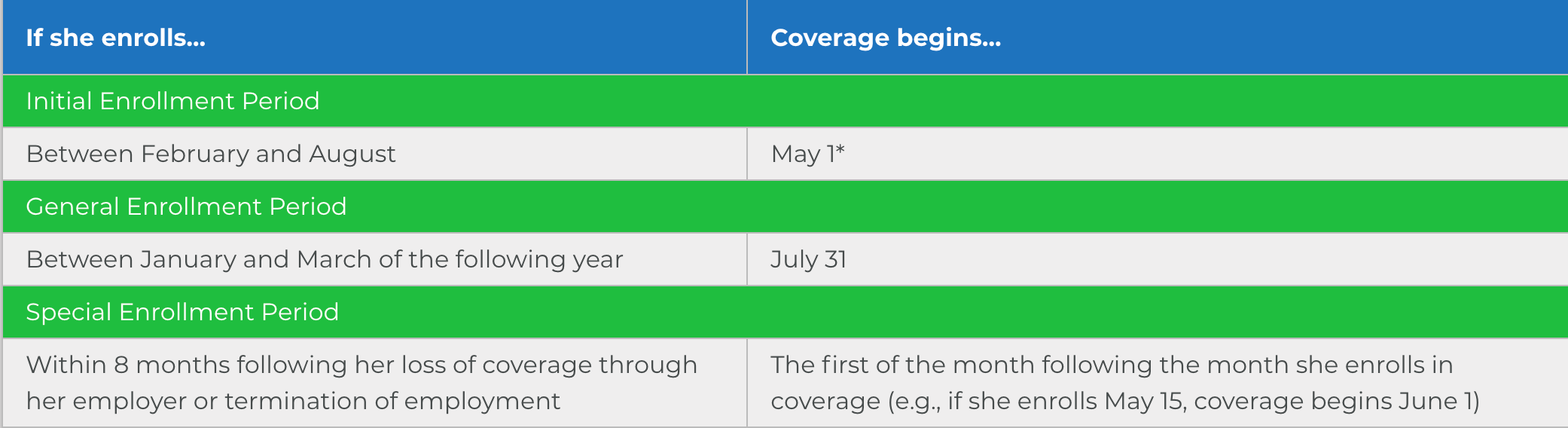
Meet Liz

  • 64. Married. Birthday is May 15.
  • Liz has a group health plan with an HSA through her employer. Here is when her Medicare coverage would start, depending on when she chooses to enroll:
  • Once Liz enrolls in Medicare, all contributions to her HSA (including her contributions and her employer’s contributions) end. Her HSA contributions are prorated for the year and she is able to use her existing funds to pay for qualified health care expenses now and when she retires.
  • Although Liz may no longer contribute or receive contributions to her HSA, she may continue to receive coverage through her group health plan—in addition to Medicare—as long as she remains enrolled in the plan. Her group health plan pays first for covered health care services she receives.** Medicare then pays for the remaining balance up to the Medicare-approved amount.

Skip to content